Showing posts with label Diabetes. Show all posts

Thursday, April 03, 2008

Can Diabetes Type 2 Be Reversed Naturally?

Raw For 30 Days

Six McDonalds-munching Americans eat 100% vegan, organic, live, raw foods for a month in order to reverse diabetes naturally. In four days, they were off insulin and in 30 days, their diabetes was totally reversed. Medical results are fantastic. They are challenged to give up meat, dairy, sugar, alcohol, nicotine, caffeine, soda, junk food, fast food, processed food, packaged food, and even cooked food – as well as go without their loved ones and many of their creature comforts – for 30 days.


"It's ridiculous," said David Wolfe, nutritionist and author. "How do you go from being insulin dependent for twenty years to no insulin at all in two weeks?" If you have diabetes type 2, has your doctor told you that you will be a diabetic for the rest of your life? Has he told you that you will always be on diabetic medicine and be dependent on insulin shots? Maybe it's time you got a new doctor.

Many medical professionals will disagree with this. They believe that once you are a diabetic, you will always be a diabetic. You might be able to control things a little better with exercise and diet but the diabetes will always be there and you will always be labeled a diabetic. Here is my question:
Well, what would you call it if they no longer take medications or insulin and their blood sugar is always normal?
I would call that REVERSED!

Doctors are trained very well by medical schools to treat the symptoms of disease. What about treating the cause? What caused us to get diabetes in the first place? A lack of drugs? Why is diet and exercise always an afterthought?

I'm not saying that you have to go to some "New Age" clinic or retreat in the deserts of New Mexico in order to reverse your diabetes. But isn't it interesting how all of these people reversed their diabetes in such a short amount of time? The question is whether or not they can keep it reversed. I must admit that I am a little skeptical. Can a 30 day program reverse a lifetime of poor lifestyle choices? What happens when they get back home to their old familiar environment? I hope they can stick with it and that there is some kind of follow up program with these folks. I look forward to watching the follow up video when they interview them again.
Dr. Julian Whitaker treats thousands of patients at the Whitaker Wellness Institute in Newport Beach, California. The clinic offers diabetic patients a "Back to Health Program." It teaches them about diet, exercise and nutrition. Click on the following link to read the testimonies and judge the results for yourself.


Whitaker Wellness Diabetes Testimonies

Sanoviv Medical Institute also treats those with diabetes in a similar fashion.

Not everyone can take the time or spend the money to go to California or Mexico. For those people, there are several programs out there that can help you and you can do it from the comfort of your own home. Here are some tips to help you with your search.

  • Make sure the program has a multi-year track record of success and has had some clinical trials done on it that you can show to your doctor.
  • Look for a program that will help you to lower or eliminate your diabetes drugs or insulin dependence.
  • Make sure that it is science-based. The people that run the program should have the letters "M.D." after their name. Being a doctor of philosophy will not suffice.
  • If it sounds too good to be true, it probably is. Stay away from gimmicks that over promise and under deliver. We would all like a "quick fix" but that isn't always a reality.
  • Make sure it lasts more than 30 days. It is highly unlikely that your diabetes will be reversed and stay reversed in as little as 30 days without continued education and motivation. Changing lifestyle habits is not a quick fix.
  • Nothing is free. It will cost you something. Think about the cost of diabetes. What is it costing you now? What is the cost of amputation and blindness? What if you no longer had to pay for meds and doctor visits? What is the value of a program that could deliver you those kinds of savings?
  • Look for a program that will put the emphasis on educating you and holding you accountable. If they just want to sell you some magic pills or an exotic elixir, this is not what you want. Success is based on helping you to learn and reinforce a new lifestyle. Education and accountability are the main keys to success.
  • Staying motivated. Look for a program that has a human element. It is great to be able to talk with a real live human being every week. If you have questions or you are just discouraged with your progress, having a mentor can be a real life saver. If they have a group that you can be a part of, that would be even better. You can learn what is working and not working from others. Besides, being part of a group is more fun.
  • Find a program that uses the power of the Internet. Having tools like an on-line journal and a forum to read or post questions or comments to can be valuable. If you are having a problem, your personal lifestyle coach can read your journal for the week and pinpoint the changes you need to make. Educational emails and healthy on-line recipes and fitness tips are a plus too.
One such program is the "Healthy For Life" program developed by Dr. Ray Strand. He wrote the book,What Your Doctor Doesn't Know About Nutritional Medicine May Be Killing You Click on the following link to read about this program.

Healthy For Life Overview

Healthy for Life: Developing Healthy Lifestyles that Have the Side-Effect of Permanent Weight Loss

Monday, December 31, 2007

Sugar Substitutes & Your Health

Years ago, people didn't eat much sugar - as little as 10-15 pounds per year. And their health was much better for it. As time passed and sugar production became easier, people gave into their sweet cravings and began to overindulge. Today, the average consumption of sugar is a whopping 160 pounds! It's suicide in slow motion. Sugar addicts eliminate 11-20 years from their lifespan.


In her book,"Lick The Sugar Habit," author Nancy Appleton Phd., delineates how this sugar overconsumption wreaks havoc with our immune and endocrine systems, leading to chronic conditions including arthritis, osteoporosis, diabetes, asthma, and hypoglycemia, along with the usual suspects such as cavities and periodontal disease.
Click Here to read my review of her book and the 73 consequences of eating too much sugar.


If you are trying to lose weight or you would just like to avoid some of these diseases, avoid sugar or try to limit it to small amounts. There are also some healthier sugar substitutes out on the market that you might want to be aware of. I am not talking about Nutrasweet or Splenda. I make a few comments on these two products at the end of this post. These have their own particular problems. I'm talking about sugar substitutes that have few or no calories and will have little or no effect on your blood sugar levels. This is good news for diabetics. Some of these have been around for hundreds of years


Agave Nectar

Derived from the prickly blue agave cactus (the same plant that gives us tequila), agave nectar is gaining popularity. Despite its sweet taste, it has just 11 calories and four grams of carbohydrate (which is mainly inulin) per teaspoon. It is also a low-glycemic food - ranking just 19 on the glycemic index.

Because this golden syrup is composed primarily of fructose (92 percent), it is nearly 25 percent sweeter than table sugar (sucrose). That means you can use a lot less to achieve the same level of sweetness.

So go ahead and sweeten up with this safe, delicious, all-natural product. It can be used anywhere you would use sugar. If you use agave nectar for baking, the following adjustments are recommended:

For every cup of sugar, use 3/4 cup of agave nectar.
Reduce the liquids in the recipe by one-third.
Reduce the oven temperature by 25 degrees.

Agave Nectar - gives you the sweetness without the sugar. Not recommended for people with diabetes but it will reduce the sugar impact levels on the blood by 50% over regular sugar. So, it is good in that way and will not cause most people to gain as much weight as regular sugars.

Stevia - the Natural Sweetener

Stevia is a green, leafy herb that grows in Central and South America. It was first discovered by modern explorers in the late 1800s in Paraguay, but it had been used by the natives for centuries before then. The official name of the plant is Stevia rebaudiana.

It's non-glycemic, contains no calories, and -- after hundreds of years of use -- has no known side effects. It might seem expensive by volume, but it's hundreds of times sweeter than sugar, so a little goes a long way. You can find stevia in any health food store.

Click Here for more links on Stevia


Sugar Alcohols

A sugar alcohol is a type of sugar that your body does not digest like "regular sugars" in the stomach. Instead, sugar alcohols get worked on in the intestines, and aren't digested into your blood stream. Sugar alcohols are commonly used in sugar free products and diet products because they are very slow to be absorbed and do not cause the "sugar rush / blood sugar spike" that normal carbohydrates cause. Many (if not most) people do not absorb sugar alcohols at all before they pass through the system. So in essence they can give great sugar flavors without having the fat-gaining effects of regular sugars. They act like fiber, but they taste like sugar. Some common types of sugar alcohols include maltitol, sorbitol and isomalt.

Xylitol - Artificial Sweetener
Xylitol is a natural sugar alcohol substitute. It was first derived from Birch trees in Finland in the 19th century and was first popularized in Europe as a safe sweetener for diabetics that would not impact insulin levels.

Xylitol is a naturally occurring sweetener found in the fibers of many fruits and vegetables, including various berries, corn husks, oats, and mushrooms. It can be extracted from corn fiber, birch, raspberries, plums, and corn. Xylitol is roughly as sweet as sucrose but contains 40% less calories.

birch bark. It has an antibacterial character to it. They are using it in nasal sprays. If you spray a salty xylitol solution up into the nose, it will kill bacteria in the nose. Trident has been using it in their gum because it has been found to fight cavities as well as inhibit ear infections. Xylitol has a 5-carbon molecular structure that does not interact with oral bacteria. Since it doesn’t ferment, it never triggers acid production. That means it helps reduce tooth decay, inhibits plaque buildup, retards the loss of tooth enamel, and lowers infections in the mouth and throat.

Xytitol has a cooling effect on the tongue and has been used for over 25 years in various food items. It is not a ZERO calorie food. It scores only seven on the glycemic index, so it has a minimal effect on blood sugar and insulin levels (and can actually help prevent tooth decay).

And because it inhibits plaque buildup, xylitol also helps prevent heart disease. Here’s why: Plaque build-up creates a breeding ground for bacteria. The resulting inflammation leads to a breakdown of gum tissue. This breakdown allows bacteria to pass into your bloodstream. The release of oral bacteria into your bloodstream stimulates an immune response. This inflammatory response causes arterial blockages and blood clots, which can lead to a heart attack.

What’s more, xylitol is low-glycemic. It doesn’t need insulin to metabolize, and won’t cause fat gain like regular sugar. It’s perfect for diabetics, and is sometimes referred to as "diet sugar."
Xylitol is affordable and easy to find. Check your local health food store or find it on the Internet. Along with stevia, xylitol is one of the safest and best-tasting sugar substitutes.


While it is safe, one of the downsides of xylitol is that it is a sugar alchohol and that can cause loose stools and minor gastrointestinal upset. So if you are already having problems in that area, xylitol would not be good to take.

Luo Han Guo

Luo han guo is a member of the gourd family. It’s low glycemic, heat stable, has a mere four calories per teaspoon, and can be used in baking just like sugar. But the benefits don’t end there. New research suggests luo han guo may actually help reduce inflammation and enhance immunity, especially in people who have diabetes.

You’re likely to hear much more sweet talk about this up-and-coming ingredient. Look for Jarrow Formulas’ Lo Han Sweet at your local health food store.

Erythritol

Erythritol occurs naturally in some fruits and fermented foods. As a sweetener, it is made from corn via a natural fermentation process. And the properties of this great-tasting, natural sweetener are remarkable:

Erythritol is 80 percent as sweet as sugar. However, unlike sugar, which is high in calories, erythritol is almost calorie free.

It scores just over zero on the glycemic index. That means it is totally safe for diabetics and won’t affect your insulin levels.

It is granulated, just like sugar, so it can be easily substituted for sugar in recipes.
It is easy to digest - which means no gastrointestinal disturbance.

Quite simply, this is one of the best natural sweeteners to come along in quite some time, and you’ll likely be seeing it in more and more products.
One of the products that I have seen on the market is a product called Zsweet. Click here to go to their web page.

Sucralose/Splenda


Splenda is actually "sucralose", and is made by in essence altering real sugar. Invented in a pesticide lab, this chemical is 600 times sweeter than sugar. To make sucralose, chlorine is used. Chlorine has a split personality. It can be harmless or it can be life threatening. In combo with sodium, chlorine forms a harmless ionic bond to yield table salt. When used with carbon, the chlorine atom in sucralose forms a covalent bond. The end result is deadly organochlorine, known simply as RNFOC (a Really Nasty Form of Chlorine). Unlike ionic bonds, covalently bound chlorines are a big no-no for the human body. They yield insecticides, pesticides, and herbicides - not something you want in your sports drink or your child's lunchbox. Chlorinated molecules, which are used as the basis for pesticides such as DDT, tend to accumulate in body tissues. Johnson & Johnson maintains that sucralose passes through the digestive system without any absorption or metabolization, but the FDA’s own research has shown that 11 to 27 percent of sucralose is absorbed in humans, while the rest is excreted unchanged in the feces. Tests performed by the Japanese Food Sanitation Council have found that as much as 40 percent of ingested sucralose is absorbed.

Additionally, as the FDA again acknowledges, sucralose may contain up to 2 percent of various impurities, such as heavy metals, arsenic, triphenilphosphine oxide, methanol, chlorinated disaccharides and chlorinated monosaccharides. Even if these "impurities" are within existing manufacturing guidelines, they are still all potentially dangerous to human health.

There have been no independent human tests regarding the long-term safety of this product. That's reason enough to be wary. But there was a study of its effect on rats that was published in the FDA's Federal Register. It showed that rats that were given sucralose experienced shrunken thalamus glands, enlarged livers and kidneys, reduced growth rate, reduced red blood cell count, aborted pregnancies, and diarrhea.

If you ingest Splenda in any amount, I urge you to read firsthand accounts of its harmful effects. There are more than 30 posted on Dr. Mercola's website.

Health and Aspartame Sweetener

Aspartame is the primary component in Nutrasweet, Equal, Spoonful and Equal-Measure. It is a neuroexitotoxin. Phenylalanine is a hidden danger to anyone consuming aspartame. Most consumers don't know that too much Phenylalanine is a neurotoxin and excites the neurons in the brain to the point of cellular death. Phenylalanine is 50% of aspartame, and to the degree humans consume diet products, Phenylalanine levels are reaching a dangerous peak. ADD/ADHD, emotional and behavioral disorders can all be triggered by too much Phenylalanine in the daily diet. This sugar substitute is common in many foods, but many doctors feel it causes serious mental slowdowns when taken over several years. Dr. Atkins in particular advised those on his low carb diet to stay away from aspartame and use other sweeteners instead.

Some people react to aspartame immediately, while others can take 10 to 20 years for the aspartame reaction to become noticeable. Problems attributed to aspartame include:

* anxiety and panic attacks
* problems concentrating and focusing
* loss of memory
* depression or irritability
* dizziness
* headache or migraine pain

The byproducts of sodas containing aspartame are all known poisons (that would slowly kill you): methanol, phenylalanine, and aspartic acid.

Thursday, April 06, 2006

Supplemental vitamin D and calcium reduces risk of diabetes


The incidence of type-2 diabetes is lower among women who get adequate calcium and supplement with vitamin D. Researchers used data from the Nurses Health Study, which includes over 83,000 women, to study the relationship of calcium and vitamin D intake to type-2 diabetes.

After 20 years of follow-up, it was concluded that a combined daily intake of over 1,200 mg of calcium and more than 800 IU of vitamin D was associated with a 33 percent lower risk of type-2 diabetes. Interestingly, dietary vitamin D intake did not appear to provide any statistically significant benefit. But the women who supplemented with at least 400 IU of vitamin D had a 13% lower risk of diabetes when compared to those who took less than 100 IU per day. Both dietary and supplemental calcium resulted in decreased risk of type-2 diabetes, and those with overall intakes above 1,200 mg had a 21% lower risk than those who got less than 600 mg per day.

Elevated intakes of calcium and vitamin D, especially from supplements, are significantly associated with lower incidence of type-2 diabetes.

Diabetes Care 29:650-656, 2006


Friday, March 03, 2006

Depressed and Diabetic


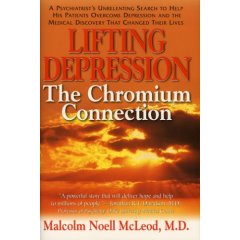
Do you, or someone you know struggle with some of the following: fatigue, high cholesterol, carbohydrate/sugar cravings, weight gain, high blood pressure or have you been diagnosed with atypical depression? This book could be the breakthrough you've been waiting for.

It sounds too good to be true, but when the peer reviewed scientific literature backs up the claims, you have to sit up and take notice.

In this fabulous book, Dr. McLeod shares his incredible & accidental discovery that a nutrient deficiency (Chromium) is at the root of a glucose metabolism problem "insulin resistance" that can lead to a suite of health symptoms (above) that include atypical depression.

The book outlines how a simple supplementation with Chromium Picolinate at the right dosage along with excerise and diet changes, lead to dramatic and complete relief for many people in as little as 2 days. Dr. McLeod chronicles the story of this discovery as he experiences the joy and surprise of many of his patients as they encounter relief from depression (and much more). Most of them report a dramatic elevation in mood, increased energy, reduced cravings for carbohydrates and vivid color in their dreams. One patient (Sarah) found that chromium picolinate relieved almost all her symptoms of PMS. She said, "Chromium eliminates my irritability, depression, hyper-sensitivity to light and noise, craving for sweets, cramps, and I'm able to work and be around people." Another patient found that chromium reduced their craving for alcohol.

Unfortunately, western diets that are high in refined carbohydrates such as white potatoes, white rice, white sugar, white bread, pastries and pasta help to increase urinary excretion of chromium by up to 300%. This is one reason why Type II diabetes is most common in countries with a high consumption of refined carbohydrates. When it comes to food, a good rule of thumb is . . ."If it's white, it ain't right!"

Chromium deficiency is common in the United States. Taking supplemental chromium has been shown to significantly improve insulin function, decrease fasting glucose, cholesterol and triglyceride levels and also to increase beneficial HDL cholesterol. The protective role of chromium is further supported by the fact that diabetes is rare in Africa, China and other countries where whole, unrefined foods are the staples in the diet (other factors preventing diabetes in those countries include high-fiber, low calorie diets and exercise). Taking 200 to 1,000 mcg of tri-valent chromium (also called GTF or "Glucose Tolerance Factor" chromium) can help control symptoms in persons deficient in chromium but is not enough to completely control or reverse diabetes. A good diet, exercise and possibly other nutritional supplements are also essential.