Showing posts with label depression. Show all posts

Wednesday, August 20, 2008

Suicide, Depression And Violent Behavior Linked To Low Cholesterol

Lowering our cholesterol seems to have become a national competition of sorts. Doctors are handing out cholesterol lowering drugs like they were candy. During follow up appointments, patients are congratulated for lowering their cholesterol and encouraged to get it even lower. Although high cholesterol has been connected to heart disease and stoke, could low cholesterol have some equally nasty side effects?

An eight-year Finnish study of 29,133 men aged 50 to 69, published in the British Journal of Psychiatry, found that those reporting depression had significantly lower average blood cholesterol levels than those who did not. After eight years, they found that 280 had been hospitalized for major depression and 111 had committed suicide.

They reported a link between low levels of blood cholesterol and a fall in levels of the neurotransmitter serotonin in the brain.

Serotonin is thought to control moods and low levels have been linked to depression and aggression.

A team from St Vincent's Hospital, Dublin, compared 100 patients admitted to the hospital with self-inflicted injuries, including drug overdoses, with psychiatric patients and patients not suffering from any mental health problems.

The patients were rated on their level of depression, impulsivity and suicidal intent.

It was found that cholesterol levels in the patients who had deliberately harmed themselves were significantly lower than the other patients.

Cholesterol levels were also low in all patients who were rated as being impulsive. Lead researcher Dr Malcolm Garland said people who deliberately harmed themselves often had no intention of killing themselves.

Dr Garland said impulsivity stimulated by low cholesterol levels could be responsible for many types of dangerous behavior. For instance impulsive people might be more prone to road traffic accidents.

Statins may produce irritability or short temper in some people, a problem that occurs with statin therapy and resolves with its discontinuation (Golomb et al., 2004).

Low cholesterol linked to depression

Suicide link to cholesterol

Cholesterol And Violence: Is There A Connection?

Saturday, March 01, 2008

Winning The War Against Depression


Everybody gets the blues now and then. President Abraham Lincoln suffered with and fought depression throughout his lifetime. However, his ability to cope with whatever depression afflicted him, especially late in life, was enormous. Using various means.... work, humor, fatalistic resignation, or even religious feelings... he generally did not allow the depression or melancholy to interfere with his work as President. He overcame this depressive aspect of his personality with a powerful inner strength and will. He once said:

"Remember in the depth and even the agony
of despondency, that very shortly you are to feel well again."
There are indications Lincoln took a medication for his hypochondriasis (depression) called blue mass. This was a commonly prescribed medication in the 19th century for ailments such as apoplexy, worms, tuberculosis, toothaches, constipation, and hypochondriasis (depression). Blue mass contained mercury and can lead to the neurobehavioral consequences of mercury poisoning. John Stuart said that Lincoln took blue mass "before he went to Washington and for five months while he was President."

Now, in the 21st century, we use Selective Serotonin Reuptake Inhibitors (SSRIs). These would include drugs like Prozac (fluoxetine), Zoloft (sertraline), Paxil (paroxetine), Luvox (fluvoxamine) and Celaxa (citalopram). Doctors and Psychiatrists hand them out like candy. Over 23.1 million prescriptions for different forms of fluoxetine (Prozac) were filled in the United States in 2006. This makes it the third most prescribed antidepressant. The most prescribed is sertraline (Zoloft) and the second is Escitalopram (Lexapro) which is also an SSRI. Escitalopram is the S-stereoisomer (enantiomer) of the earlier Lundbeck drug citalopram (Celexa), hence the name escitalopram.


One of the things you should know about Prozac and other SSRI's is that it could take a whole month for the full benefits of the drug to take effect. Another thing you should know is that recent studies have led scientists to discover that taking SSRI's for depression might not be any better than if you took a placebo. In other words, you might be just as likely to get better by taking a sugar pill.
A paper published in the journal PLoS (Public Library of Science) Medicine last month looked at the trial results of fluoxetine (Prozac), paroxetine (Seroxat), venlafaxine (Effexor) and nefazodone (Serzone). "Using complete data sets (including unpublished data) and a substantially larger data set of this type than has been previously reported, we find the overall effect of new-generation antidepressant medication is below recommended criteria for clinical significance," they write.

After using the freedom of information rules, they obtained all of the data that was used in the clinical trials done by the drug companies. If you are a doctor, these are the ones your drug rep did not tell you about. They show the true and whole picture of the drugs effectiveness. The exception to the rule was that these drugs did seem to have a significant effect on those who were severely depressed. For every one else, it was no more effective than a placebo. Here is the article that references that study:


Prozac, used by 40m people, does not work say scientists

Now, let's look at some of the side effects of Prozac and the others. Make sure you ask your doctor or psychiatrist about these.


Gwen Olsen, a former pharmaceutical industry representative, told an FDA panel that she had influenced doctors by offering them free food, gifts and gimmicks to get access and then presented them with skillfully manipulated data. Olsen said she had a change of heart after her 20- year-old niece committed suicide following a withdrawal reaction from the antidepressant Paxil. She said her niece first tried to hang herself from a ceiling fan. When the fan broke, Olsen said, she doused herself in oil and set herself alight.

More than 1 million children and teens now receive SSRI prescriptions, estimates Julie Magno Zito, a psychiatric drug expert at the University of Maryland.

In May 1984, Germany’s regulatory agency (Bundesgesundheitsamt, BGA) rejected Prozac as “totally unsuitable for treating depression.” In July 1985, Eli Lilly’s own data analysis—from a pool of 1,427 patients—showed high incidence of adverse drug effects and evidence of drug-induced violence in some patients.

Remember the tragedy of the Columbine High School masacre? The shooter, Eric Harris, was taking Zoloft before he switched to Luvox. Three experts testified that Eric showed symptoms of being "Bipolar." According to the Physicians Desk Reference, antidepressants can induce mania & psychosis, especially in people who are 'bipolar'.


A few weeks ago, we also had a shooting in Illinois where a former student opened fire on and killed 6 people (including himself) at Northern Illinois University in DeKalb. Steve Kazmierczak was not a monster, according to friends. He was kind and gentle. He had stopped taking Prozac a few weeks before the shooting spree. According to a friend, it "made him feel like a zombie."


So, what to do about depression? Why not try some other things before drugs enter into the picture. Why should they be the first thing that we try? Shouldn't they be the last thing after looking at how inneffective and dangerous they are?

According to Dr. Andrew Weil, a variety of lifestyle, dietary and psychotherapeutic interventions have a much better record of success against depression than these drugs have ever had. Serious depression is a medical problem that in many cases demands serious pharmaceutical treatment, but patients with mild or moderate depression would be much better served trying a prudent mix of exercise, diet and cognitive therapy.


  • Cognitive-behavioral therapy, which teaches kids to change self-defeating attitudes and behaviors. It is about as effective as Prozac. Drugs should be reserved for the most severely depressed, who need therapy, too.


  • Depressed people usually have low levels of vitamin D in their blood. Have it checked by asking your doctor to do a D25-hydroxy test. Click here to check out my post on vitamin D

  • Gabriel Cousens, MD, in his very informative and helpful book, Depression-Free For Life: An All-Natural, 5-Step Plan to Reclaim Your Zest For Living, explained that chemicals called neurotransmitters relay nerve impulses throughout your body. These nerve impulses make up the communication system that your brain and nerves use to carry out many functions. (6)
    The neurotransmitters that seem to have the most impact on your moods are...
    serotonin
    dopamine
    noradrenaline (also called norepinephrine)
    glutamine
    gamma aminobutyric acid (GABA)
    endorphins

Your body produces these important chemicals from the nutrients you consume. Amino acids, vitamins, enzymes, minerals, fatty acids, proteins and carbohydrates are all needed.


  • Catherine Carrigan, in Healing Depression: A Holistic Guide, listed ten common dietary substances that are most likely to contribute to depression. These depression diet substances include...
    1. Anything moldy, malted, or fermented. 2. Anything processed. 3. Anything dried or aged.4. Anything made with sugar or honey.5. Anything made with yeast.6. Any meat raised with antibiotics or steroids.7. Leftovers unless frozen.8. Alcoholic beverages, coffee, tea, chocolate, and colas.9. Food colorings, chemicals, preservatives, and additives.10. Tap water." (4, pp. 126-7)


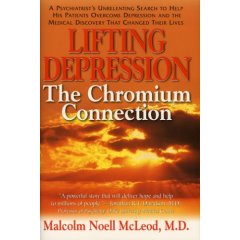
  • If you have been diagnosed with atypical depression, you might greatly benefit from learning about a mineral called chromium picolinate. Dr. Malcom McLeod, in his book "Lifting Depression, The Chromium Connection," discovers by "accident" that a nutrient deficiency (Chromium) is at the root of a glucose metabolism problem "insulin resistance" that can lead to a suite of health symptoms (above) that include atypical depression. The book outlines how a simple supplementation with Chromium Picolinate at the right dosage along with excerise and diet changes, lead to dramatic and complete relief for many people in as little as 2 days. Dr. McLeod chronicles the story of this discovery as he experiences the joy and surprise of many of his patients as they encounter relief from depression (and much more). Most of them report a dramatic elevation in mood, increased energy, reduced cravings for carbohydrates and vivid color in their dreams. One patient (Sarah) found that chromium picolinate relieved almost all her symptoms of PMS. She said, "Chromium eliminates my irritability, depression, hyper-sensitivity to light and noise, craving for sweets, cramps, and I'm able to work and be around people." Another patient found that chromium reduced their craving for alcohol.

Other blog entries that talk about dealing with depression in a natural way:

Alternative Medicine Help for Seasonal Depression

Ten Ways to better Cope with Depression


Friday, March 03, 2006

Depressed and Diabetic


Do you, or someone you know struggle with some of the following: fatigue, high cholesterol, carbohydrate/sugar cravings, weight gain, high blood pressure or have you been diagnosed with atypical depression? This book could be the breakthrough you've been waiting for.

It sounds too good to be true, but when the peer reviewed scientific literature backs up the claims, you have to sit up and take notice.

In this fabulous book, Dr. McLeod shares his incredible & accidental discovery that a nutrient deficiency (Chromium) is at the root of a glucose metabolism problem "insulin resistance" that can lead to a suite of health symptoms (above) that include atypical depression.

The book outlines how a simple supplementation with Chromium Picolinate at the right dosage along with excerise and diet changes, lead to dramatic and complete relief for many people in as little as 2 days. Dr. McLeod chronicles the story of this discovery as he experiences the joy and surprise of many of his patients as they encounter relief from depression (and much more). Most of them report a dramatic elevation in mood, increased energy, reduced cravings for carbohydrates and vivid color in their dreams. One patient (Sarah) found that chromium picolinate relieved almost all her symptoms of PMS. She said, "Chromium eliminates my irritability, depression, hyper-sensitivity to light and noise, craving for sweets, cramps, and I'm able to work and be around people." Another patient found that chromium reduced their craving for alcohol.

Unfortunately, western diets that are high in refined carbohydrates such as white potatoes, white rice, white sugar, white bread, pastries and pasta help to increase urinary excretion of chromium by up to 300%. This is one reason why Type II diabetes is most common in countries with a high consumption of refined carbohydrates. When it comes to food, a good rule of thumb is . . ."If it's white, it ain't right!"

Chromium deficiency is common in the United States. Taking supplemental chromium has been shown to significantly improve insulin function, decrease fasting glucose, cholesterol and triglyceride levels and also to increase beneficial HDL cholesterol. The protective role of chromium is further supported by the fact that diabetes is rare in Africa, China and other countries where whole, unrefined foods are the staples in the diet (other factors preventing diabetes in those countries include high-fiber, low calorie diets and exercise). Taking 200 to 1,000 mcg of tri-valent chromium (also called GTF or "Glucose Tolerance Factor" chromium) can help control symptoms in persons deficient in chromium but is not enough to completely control or reverse diabetes. A good diet, exercise and possibly other nutritional supplements are also essential.